
On Elegance
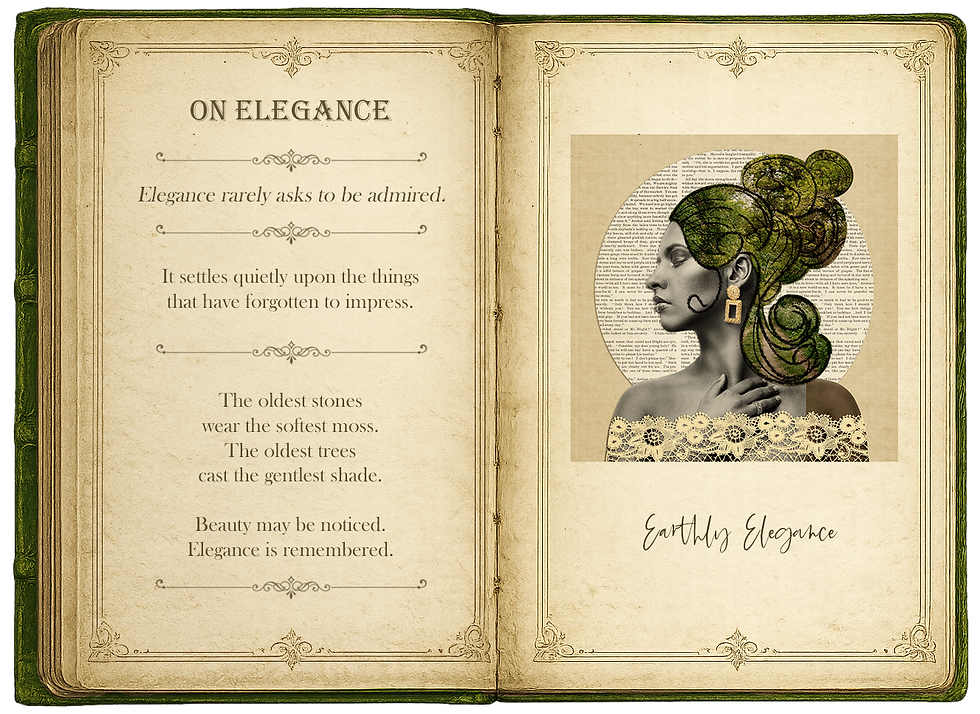
The third reflection in Roots of Reflection was titled On Elegance. The illustration opposite bore the penciled title Earthly Elegance, written in the same careful hand as the previous two illustrations.
At first, I thought I understood it. The portrait was graceful, the forest rich with winding branches, and beneath it all lay fragments of old book pages and delicate lace. It seemed simply to celebrate beautiful things.
I was wrong.
It was not long afterwards that I wandered into one of the quieter lanes of Rosecourt. Outside a small stone cottage, an elderly woman sat beside an open window with a length of yellowed lace draped across her lap. One delicate section had worn thin, and with remarkable patience she was repairing it thread by thread.
"It's beautiful," I remarked.
She smiled without looking up.
"It has always been beautiful," she said, "the elegance came later."
For a moment I wondered why she had not simply replaced it.
As though she had heard the question forming, she held the lace towards the light and said,
"It would hardly be the same lace if I replaced it."
She spoke of the lace as one might speak of an old friend, and for the first time I wondered whether the people of Thistlewood saw age not as the opposite of beauty, but as its companion.
I carried those words with me for the rest of the afternoon.
Later that day I found myself resting on an old wooden bench beneath an enormous oak. The bench leaned noticeably to one side, its legs slowly yielding to roots that had pushed gently upward over many seasons.
An elderly gardener was tending the flowerbeds nearby. Seeing me study the bench, he walked over and sat down beside me. It creaked familiarly beneath our weight.
"Doesn't it bother you that it leans?" I asked.
He looked first at the bench, then up into the great branches above us.
"It leans because the tree grew."
After a pause, he added, "We decided the tree had earned the space."
Neither the lace nor the bench had been preserved against time. They had simply been allowed to grow older with dignity. Nothing was discarded merely because it bore the marks of years. Nothing seemed embarrassed by weather, wear or gentle imperfection.
Each had always possessed its own quiet beauty. Somewhere along the way, through years of use, weather and gentle care, something else had appeared. Time had not diminished them. It had quietly bestowed upon them an elegance they could never have possessed when they were new.
It gradually occurred to me that the people of Thistlewood possessed a curious gift. They recognized elegance where others might have seen only ordinary things.
I came to suspect that Mossquill regarded this as a form of wisdom rather than taste. It was easy enough to admire the remarkable. The harder skill was learning to recognize elegance in things that had surrounded you all along. He regarded elegance as something very different from decoration. It was not found in flawless things, but in those that had lived long enough to become entirely themselves.
Since that afternoon, I have found it difficult to pass an old gate, a worn book or a moss-covered stone without pausing for a moment longer than I once would have. Perhaps elegance was never especially rare. Perhaps it simply waits patiently for someone willing to notice it.
Every page in Roots of Reflection begins with a collage. If this one found a place in your thoughts, you can find the original artwork in my shop.


Comments